It’s always fun when Chris and I are able to find an additional example of work by one of the women photographers I’ve already talked about. Today’s example: a new-to-us cabinet card by the Appelquest studio, a studio run by Emily Appelquest (in partnership with her husband before his death). I talked about the Appelquest studio in a recent blog post.
Anyway, here’s our latest acquisition of work done by the Appelquest studio:
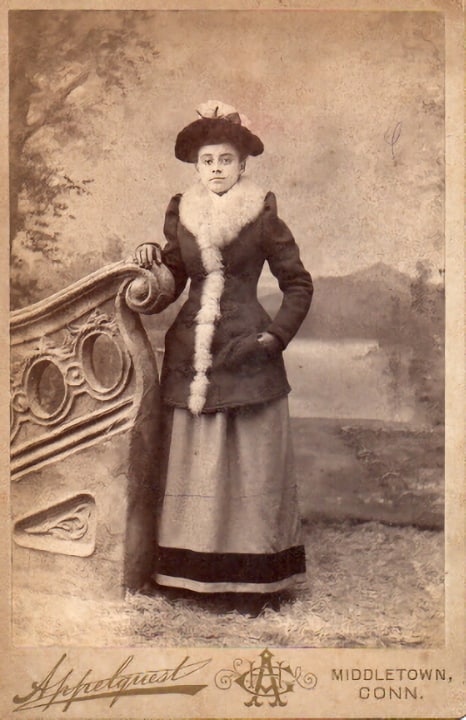
Cabinet cards, like this one, have the name of the photographer’s studio on the front under the photo. As a result, sometimes there’s nothing on the back that adds to the story – the relevant information is all on the front. Plus, the woman’s fancy coat fur-trimmed coat looks pretty, But it would have been hot to wear inside — which is where she is. Although the painted backdrop makes it look like she’s standing inside in front of a lake, she’s not – she’s definitely in the studio, standing on a “grass” carpet and leaning against a prop wall or balustrade.
It’s a nice photo, though. But sometimes, flipping the card over to look at the back can provide unexpected bonus benefits. That’s true when we look at the back of this Appelquest cabinet card. Take a look:
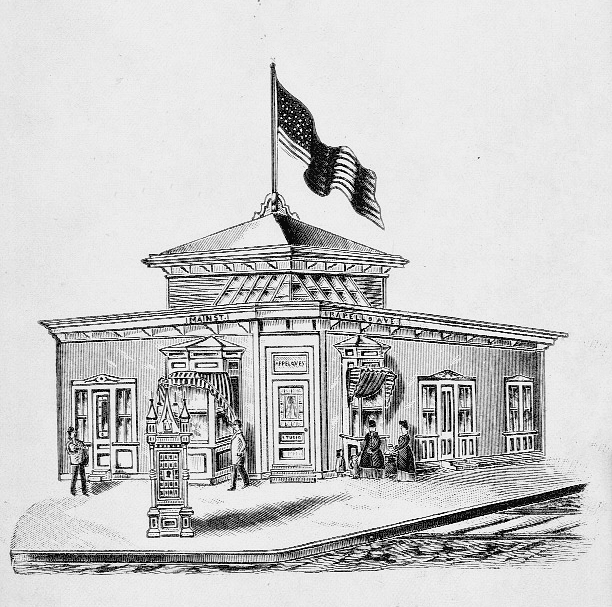
(Courtesy McIntyre-Culy collection).
That’s a sketch of the Appelquest studio itself, as it appeared in Middletown, CT in the late 19th/early 20th centuries. You can see the name of two streets: Main Street and Rapallo Street; the Appelquest studio sat on that corner (the building is no longer there, but the streets are. Note that the engraver seems to have misspelled “Rapallo” as “Rapello”). Above the street names on the building, below the roof under the flag, appear to be little windows – skylights, perhaps? Studios in this time period routinely had skylights to allow lots of light in order to get good photos.
Plus, in front of the building there is a little freestanding castle-tower-like column. That tower seems to have display of photos taken in the studio – good advertising to attract the attention of passersby.
As you can see, sometimes the flip side of the cabinet card can be just as interesting as the front, eh?